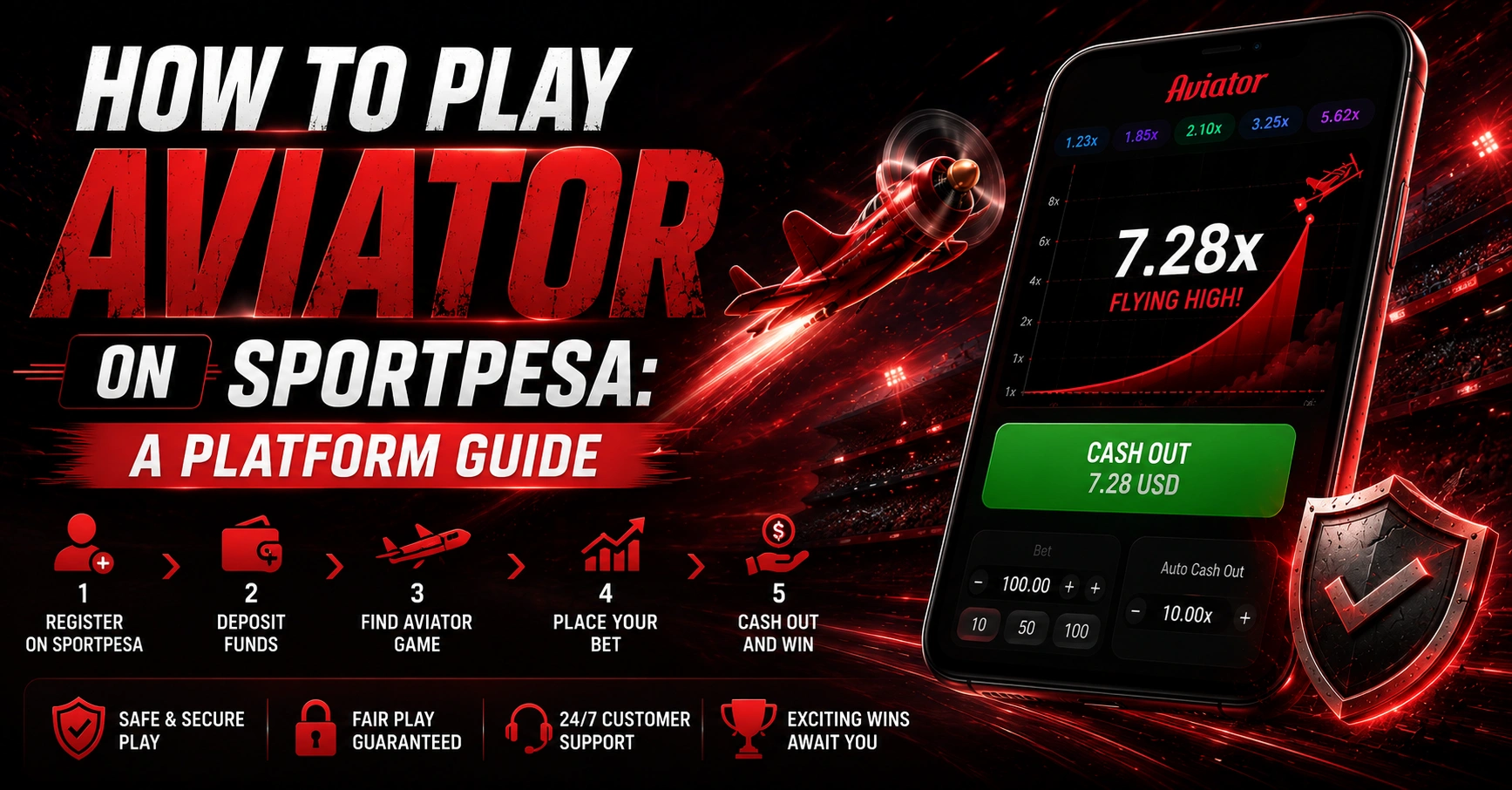
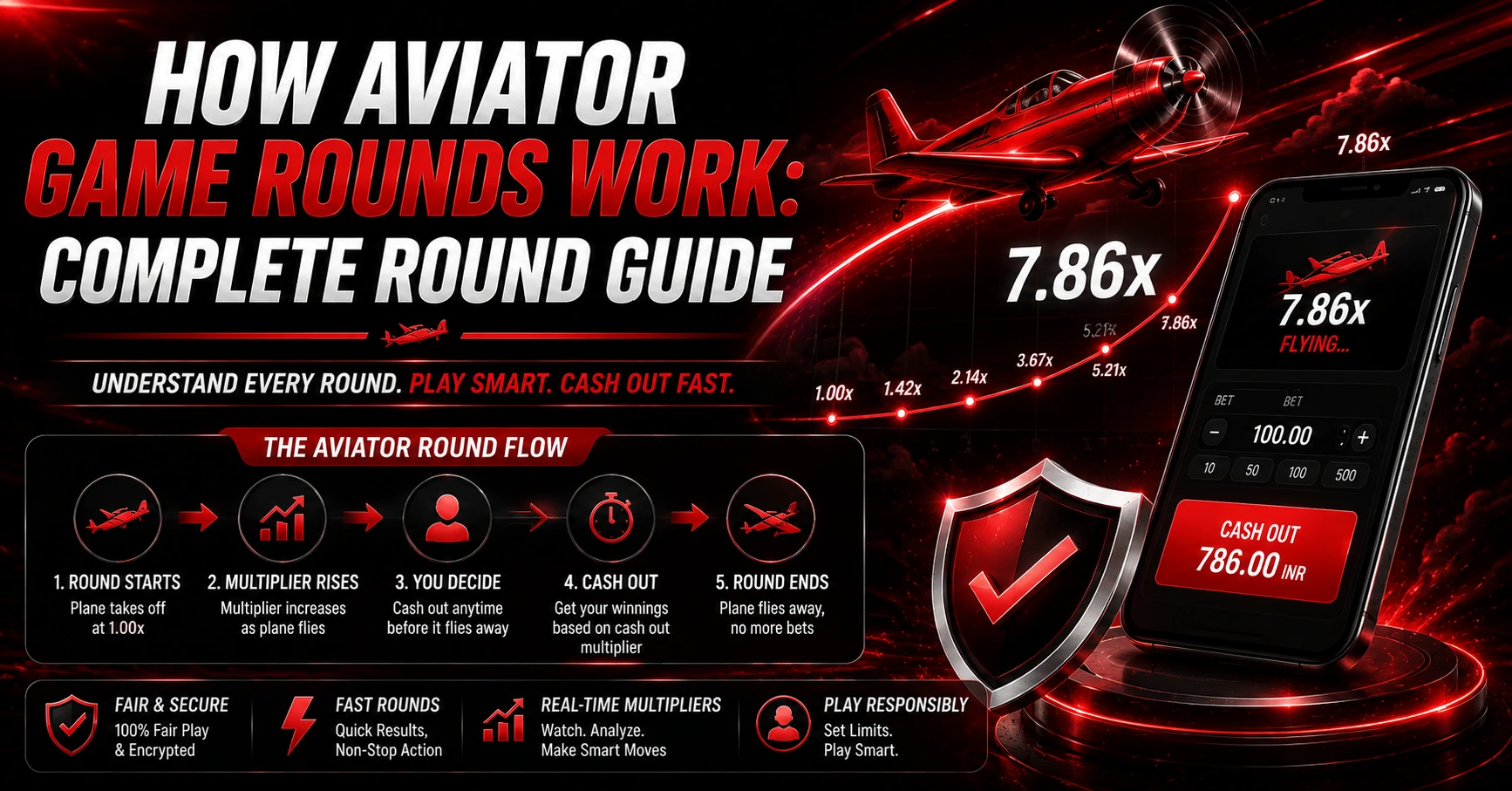
Aviator Game rounds follow a simple sequence: a new round opens, players place their bets, the aircraft appears, the multiplier rises, players can cash out, and the round ends when the aircraft flies away. Understanding this round-by-round process makes the game interface easier to follow.
This guide explains how an Aviator Game round works from beginning to end, including the betting stage, multiplier, cash-out point, crash point, round history, and the transition to the next round.
What Happens During an Aviator Game Round?
Each Aviator round follows a repeating cycle. The main stages are:
- A new round opens
- Players place their bets
- The aircraft takes off
- The multiplier starts increasing
- Players choose when to cash out
- The round reaches its crash point
- The result is recorded
- A new round begins
The important part is that the multiplier can increase while the round is active, but the round can end before a player chooses to cash out.
The Aviator Game Round Lifecycle
Understanding the complete lifecycle is the easiest way to understand how the game works.
1. A New Round Starts
A new round begins after the previous round has finished.
The game interface provides a betting window where players can prepare their bets for the upcoming round. Depending on the platform and game interface, players may see controls for entering their stake and confirming their bet.
At this stage, the aircraft has not yet completed its flight for the new round.
2. Players Place Their Bets
Before the round begins, players select their stake and place their bets.
A stake is the amount selected for that particular round. Some Aviator interfaces can support more than one betting position, allowing a player to manage multiple bets separately.
Once the betting period closes, the round moves into its flight phase.
It is important to distinguish the betting stage from the cash-out stage. A bet is placed before or as the round starts, while cashing out happens while the round is active.
3. The Aircraft Takes Off
Once the round begins, the aircraft appears on the game screen.
At the same time, the multiplier begins increasing.
For example, a round may progress through values such as:
1.00x → 1.20x → 1.50x → 2.00x → 3.00x
These numbers represent the multiplier displayed during the active round.
The exact progression and ending point are determined by the game’s underlying system.
4. The Multiplier Starts Rising
The multiplier is one of the main elements of an Aviator round.
As the aircraft continues its flight, the displayed multiplier increases.
| Stage | Example Multiplier |
|---|---|
| Round begins | 1.00x |
| Early flight | 1.25x |
| Continuing flight | 1.75x |
| Mid-round example | 2.50x |
| Later example | 5.00x |
These values are only examples of how a multiplier can be displayed during a round. A future round does not have to follow the same sequence or reach the same multiplier.
The increasing multiplier is what creates the main decision point for players: whether to cash out at the current multiplier or continue waiting.
5. Players Choose When to Cash Out
While the round is active, a player can use the cash-out function when available.
For example, if a player cashes out when the displayed multiplier is 2.00x, the applicable result is based on that cash-out point and the stake used for the bet.
The basic relationship is:
Stake × Cash-Out Multiplier = Gross Payout
For example, with a hypothetical ₹100 stake and a successful cash-out at 2.00x:
₹100 × 2.00 = ₹200
This is a simplified example and does not account for any platform-specific conditions or deductions.
The important point is that the cash-out must occur before the round reaches its crash point.
6. The Round Reaches Its Crash Point
At some point, the aircraft leaves the active flight and the round ends.
The multiplier displayed at that moment represents the crash point for that round.
For example, a round might end at:
1.18x
while another might end at:
3.72x
and another could end at:
8.45x
The ending point can vary from round to round.
Players who have already successfully cashed out before the crash point have completed their cash-out for that round. A player who has not cashed out before the round ends does not receive a successful cash-out for that bet.
7. The Round Result Is Recorded
After the aircraft leaves, the completed round becomes part of the game’s history.
Players may be able to see previous round multipliers in the round history area of the interface.
For example:
| Round | Final Multiplier |
|---|---|
| Previous Round | 1.34x |
| Previous Round | 2.76x |
| Previous Round | 1.09x |
| Previous Round | 4.18x |
| Previous Round | 6.51x |
Round history is useful for reviewing previous results, but previous multipliers should not be treated as a guaranteed way to determine what will happen in the next round.
8. The Next Aviator Round Begins
Once the result of the previous round is displayed, the game moves into the next round.
The process starts again:
New Round → Bet → Aircraft → Rising Multiplier → Cash Out → Crash Point → Result
This repeating cycle is the basic structure behind Aviator gameplay.
How Does the Aviator Multiplier Work During a Round?
The multiplier represents the changing value displayed while the aircraft is flying.
It starts from the beginning of the round and rises as the round continues.
For example:
1.00x → 1.15x → 1.40x → 1.90x → 2.80x
A player who cashes out at an earlier multiplier accepts a lower multiplier in exchange for completing the cash-out before the round ends.
Waiting longer may allow the multiplier to become higher, but it also means the round could end before the player cashes out.
This is why the multiplier and cash-out functions are closely connected.
For a deeper explanation, you can create a dedicated Aviator Multiplier Explained page and link to it from this section.
What Is the Aviator Crash Point?
The crash point is the point at which the active Aviator round ends.
When the aircraft leaves the screen, the multiplier stops increasing and the round is complete.
For example:If a round ends at 3.45x, then 3.45x is the final multiplier for that round.
The crash point is different from a player’s cash-out point.
Cash-out point
The multiplier at which a player successfully exits the round.
Crash point
The multiplier at which the round itself ends.
A player needs to cash out before the crash point to complete a successful cash-out.
What Happens If You Don't Cash Out Before the Crash?
If a player remains in the round when the aircraft reaches its crash point, the player has not completed a cash-out before the round ended.
For example:
- Player’s bet: ₹100
- Round reaches: 1.50x
- Player does not cash out
- Round ends at 1.50x
Because no cash-out was completed before the round ended, the player does not receive a successful cash-out payout for that bet.
The exact account treatment can depend on the platform’s terms and game implementation.
How Does Aviator Round History Work?
Round history shows results from completed rounds.
It may display a series of previous multipliers, helping players review what happened in earlier rounds.
For example:
1.04x | 2.31x | 1.72x | 5.40x | 1.16x
This information represents past rounds.
It is important not to confuse historical results with predictions. A sequence of previous multipliers does not guarantee what the next round will produce.
For example, seeing several low multipliers in a row does not mean that a high multiplier must occur next.
Can Previous Aviator Rounds Predict the Next Round?
Previous rounds cannot be treated as a reliable guarantee of the next crash point.
A common mistake is assuming that a particular sequence must be followed by a specific result.
For example:
1.20x → 1.35x → 1.10x → therefore the next round must be high.
There is no sound basis for treating that sequence as a guaranteed prediction.
Similarly, websites or tools claiming that they can guarantee the next Aviator multiplier should be approached with caution.
Round history is historical information, not a guaranteed forecast.
How Does Provably Fair Technology Relate to Aviator Rounds?
Aviator is associated with provably fair gaming technology, which is designed to provide a way of verifying the fairness of game results.
Depending on the implementation, concepts such as:
- Server seed
- Client seed
- Hash
- Randomization
- Result verification
can be involved in the verification process.
The purpose of a provably fair system is to allow players or third parties to verify how a result was generated rather than simply relying on an unexplained result.
For a deeper technical explanation, this topic is better covered in a separate article such as:
Example of a Complete Aviator Game Round
Let’s look at a simple example.
Step 1: Betting
A player places a hypothetical ₹100 stake before the round begins.
Step 2: Aircraft Takes Off
The round starts and the aircraft appears.
Step 3: Multiplier Rises
The multiplier moves upward:
1.00x → 1.25x → 1.50x → 2.00x
Step 4: Cash Out
The player chooses to cash out at 2.00x.
Using the simplified example:
₹100 × 2.00 = ₹200
Step 5: Round Continues
The aircraft continues flying after the player’s cash-out.
Step 6: Crash Point
The round eventually ends at 3.40x.
The player’s cash-out had already occurred at 2.00x, so the later crash point does not change that completed cash-out.
Step 7: Next Round
The result is recorded and the next round opens.
This example shows the difference between a player’s cash-out multiplier and the round’s final crash multiplier.
Tip: How to Play Aviator Game.
Aviator Round vs Cash-Out Point
These two concepts are often confused.
| Term | Meaning |
|---|---|
| Round | One complete cycle of Aviator gameplay. |
| Multiplier | The value that rises while the round is active. |
| Cash-out | The player's decision to exit the active round. |
| Cash-out Multiplier | The multiplier displayed when the player successfully exits the round. |
| Crash Point | The multiplier at which the active round ends. |
| Round History | A record of completed round results and their final multipliers. |
Understanding these terms makes the game interface much easier to follow.
Does Every Aviator Round End at the Same Multiplier?
No.
The final multiplier can differ between rounds.
One round may end relatively early, while another may continue to a higher multiplier.
For example:
Round A: 1.12x
Round B: 2.84x
Round C: 1.46x
Round D: 7.25x
These examples demonstrate why each round should be treated as its own event rather than assuming that the previous round determines the next one.
How Long Does an Aviator Game Round Last?
There is no single fixed duration that applies to every round.
A round’s length depends on when its crash point is reached.
A round that ends at a lower multiplier can finish quickly, while a round that reaches a higher multiplier can remain active for longer.
The important factor is therefore the round’s actual ending point, rather than expecting every round to last for a fixed number of seconds.
Can You Use Round History to Choose a Cash-Out Target?
Round history can help players understand what happened in previous rounds, but it should not be treated as a reliable prediction system.
A player may choose a personal cash-out approach based on their own risk limits, but no previous sequence can guarantee that a particular multiplier will appear in the next round.
Avoid claims such as:
- “Guaranteed 10x strategy”
- “Next-round predictor”
- “100% crash prediction”
- “Guaranteed Aviator hack”
Such claims can be misleading.
Common Mistakes When Understanding Aviator Rounds
Mistake 1: Confusing the crash point with cash-out
The crash point is the end of the round. The cash-out point is when the player exits.
Mistake 2: Assuming a high multiplier must come next
Previous results do not guarantee the next result.
Mistake 3: Treating round history as a prediction tool
History shows completed rounds. It does not provide certainty about future rounds.
Mistake 4: Waiting without understanding the risk
A higher displayed multiplier can mean a potentially larger payout, but waiting longer also means the round could end before a player cashes out.
Mistake 5: Trusting predictor or hack claims
Tools claiming guaranteed future multipliers should not be treated as reliable simply because they display previous round data.
Aviator Game Round FAQs
How does an Aviator Game round start?
What happens during an Aviator round?
What is the crash point in Aviator?
What happens if I cash out before the crash?
What happens if I don't cash out?
Does every Aviator round have the same multiplier?
Can previous rounds predict the next Aviator round?
What is Aviator round history?
Is the Aviator crash point predictable?
Final Thoughts on How Aviator Game Rounds Work
An Aviator Game round follows a straightforward cycle: betting, aircraft launch, rising multiplier, cash-out opportunity, crash point, result, and the start of the next round.
The most important concepts to understand are the difference between the multiplier, cash-out point, and crash point. Round history can show what happened previously, but it should not be treated as a guaranteed way to predict future results.
Understanding this round lifecycle gives players a clearer picture of how the Aviator interface works and how each round progresses from start to finish.